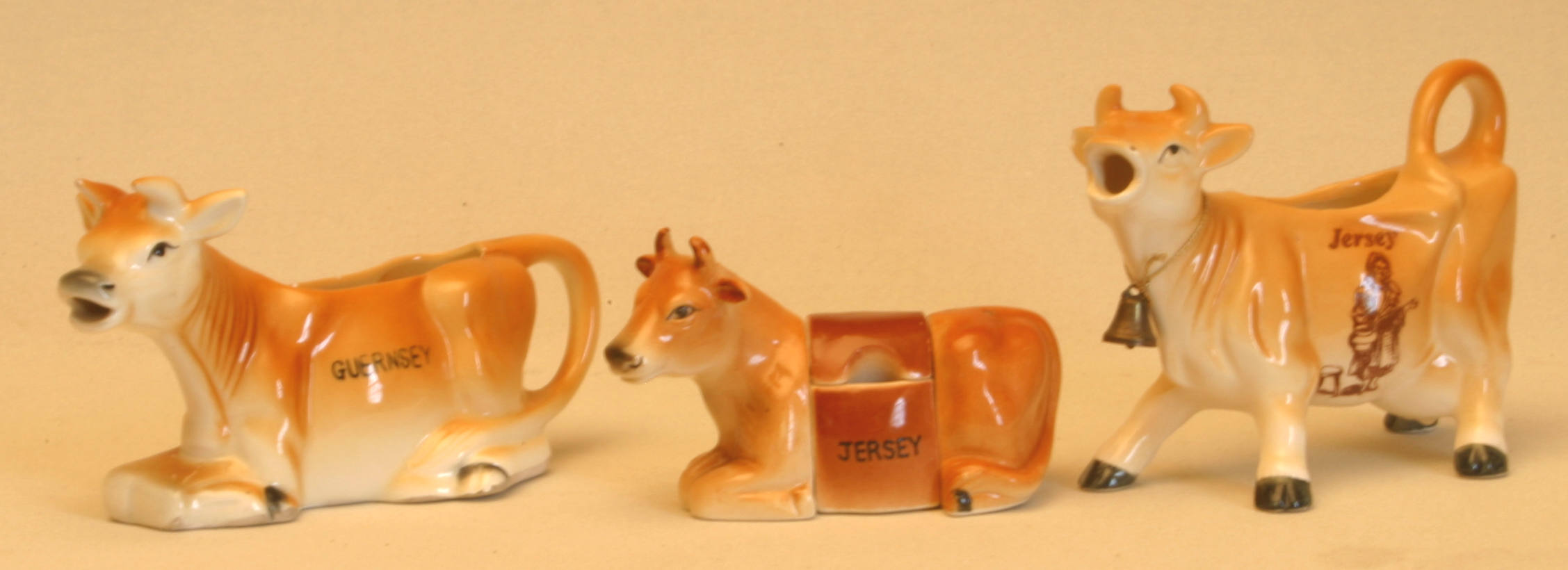
Guernsey & Jersey Jugs

Home Up Button and Badge  Makers Copper Ores Design Developments Diamonds Candlesticks Festival of Britain French Copper German Copper Guernsey & Jersey Jugs HMS Victory Copper Industrial Souvenirs Isle of Man Brass Mints and Medalists Not Brass or Copper Nottingham Tankards Oil Lamp Makers Copper from Poland Real Deal Ruskin Cabouchons Swedish Copperware Three Wise Monkeys Unidentified

(C) Vin Callcut 2002-2013  Small extracts can be used with acknowledgements to 'Oldcopper.org website'. 

Helpful comments are very welcome.


Guernsey and Jersey Jug / Can / Creamer

Makers and Retailers

  General Text on the Left   A selection of Retailers and Maker's Names below:
  (For simplicity the word 'jugs' is here used to cover 'cans' and 'creamers'.  The jugs were dual purpose to be used as milk cans for the collection of the milk.  Being so attractive, they are suitable for use at table as jugs or creamers.  Channel Island 'milk' is so rich in 'cream' that those words can justifiably be confused as well.)  
      R Agnew, 28 High Street
  This is just one of the topics to be covered in greater detail in the book.  It briefly describes the jugs and shows the marks of some of the makers or vendors of a very practical container and dispenser for their high-cream milk.  More information will be included as it becomes available.   
      Army and Navy Stores, London.


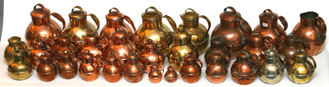
 Many collectors have special affection for the copper cream jugs typically made in the Channel Islands, particularly Guernsey.  The design is traditional, being based on the design of French milk jugs and going back about a thousand years.  It has been continued on Guernsey and Jersey, islands in the Channel Island group, now popular holiday resorts.  For years the jugs were used for regular deliveries of milk to local residents long after other areas had switched to the use of glass bottles.   


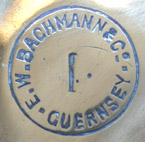
  The design appealed to visitors and during the 20th century, more jugs were made for sale to tourists. Some of the jugs made for tourists are not made by the traditional methods and not of the quality needed for regular use.  Most were made in Birmingham or The Black Country and sent to Guernsey ready marked for retailers.   Bachman, E W

Jewellers of 47, High Street, St Peter Port.

  With the jug may go an enthusiasm for the richly creamy milk of the Guernsey and Jersey cows, herds are now also found on the mainland.  Similar jugs were made on the neighbouring island of Jersey but are not do common.  The Channel Islands have been part of Britain since 1066, being then part of the estate of William, Duke of Normandy.  
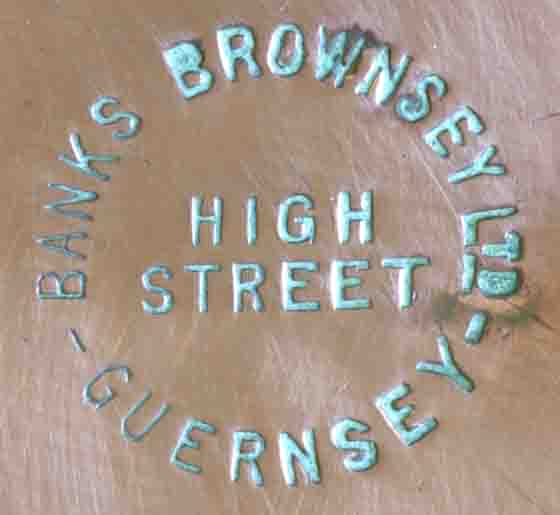
       Banks Brownsey
  Effective sizes of jug range from half-pint up to one gallon, occasionally more.  Miniatures have been made occasionally.   The standard Guernsey measure was the ‘Pot’, equivalent to about four pints or half a gallon.  Cans have been made up to a five gallon size (10 pots) but three gallons (6 pots) was the maximum practical size for use.   
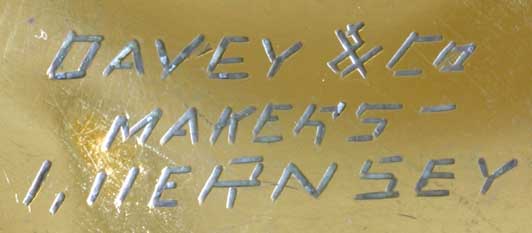
      Davey & Co.
  The larger sizes are very rare.  There have been several coppersmiths making them, originally for local use and then for sale to tourists.  Many of the jugs have the bottom showing the maker’s mark and a number representing the capacity, either in pints or pots.  Many makers did not resume production after 1945 but at least one is still in business and has a website, see page below this.  
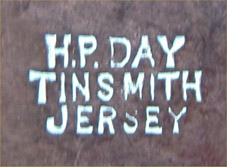
      H P Day, Jersey
   Some jugs were made on the mainland and the ‘Loveridge’ mark is frequently found.  Others may have been sent to the Islands pre-marked to order or unmarked so that retailers could add their own.  Many of the jugs are of excellent quality and show a good age.  Some are made of brass.  Some made for the cheap end of the tourist trade are not of such good quality.  
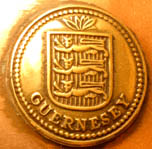
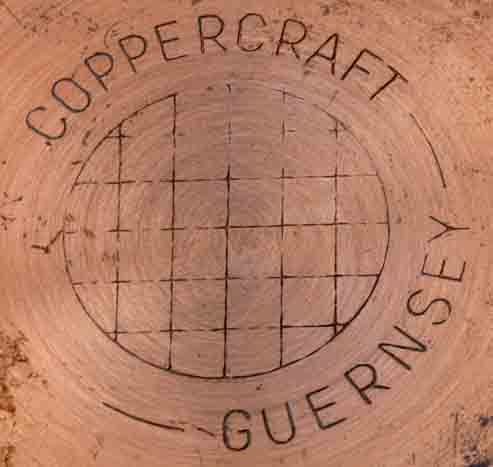
      Guernsey Copper Craft
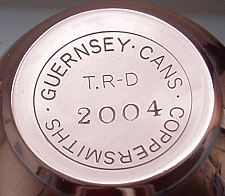
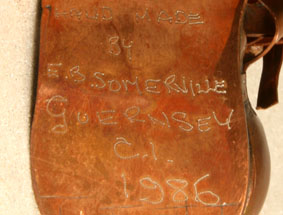
    This stamp comes from the only coppersmith still making the jugs traditionally.   It also carries the year of manufacture.    

         http://www.guernseycans.co.uk/

 
      Guernsey Cans (Coppersmiths)
 
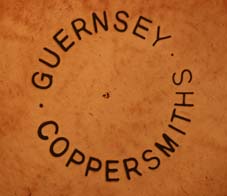
  Guernsey Coppersmiths
     
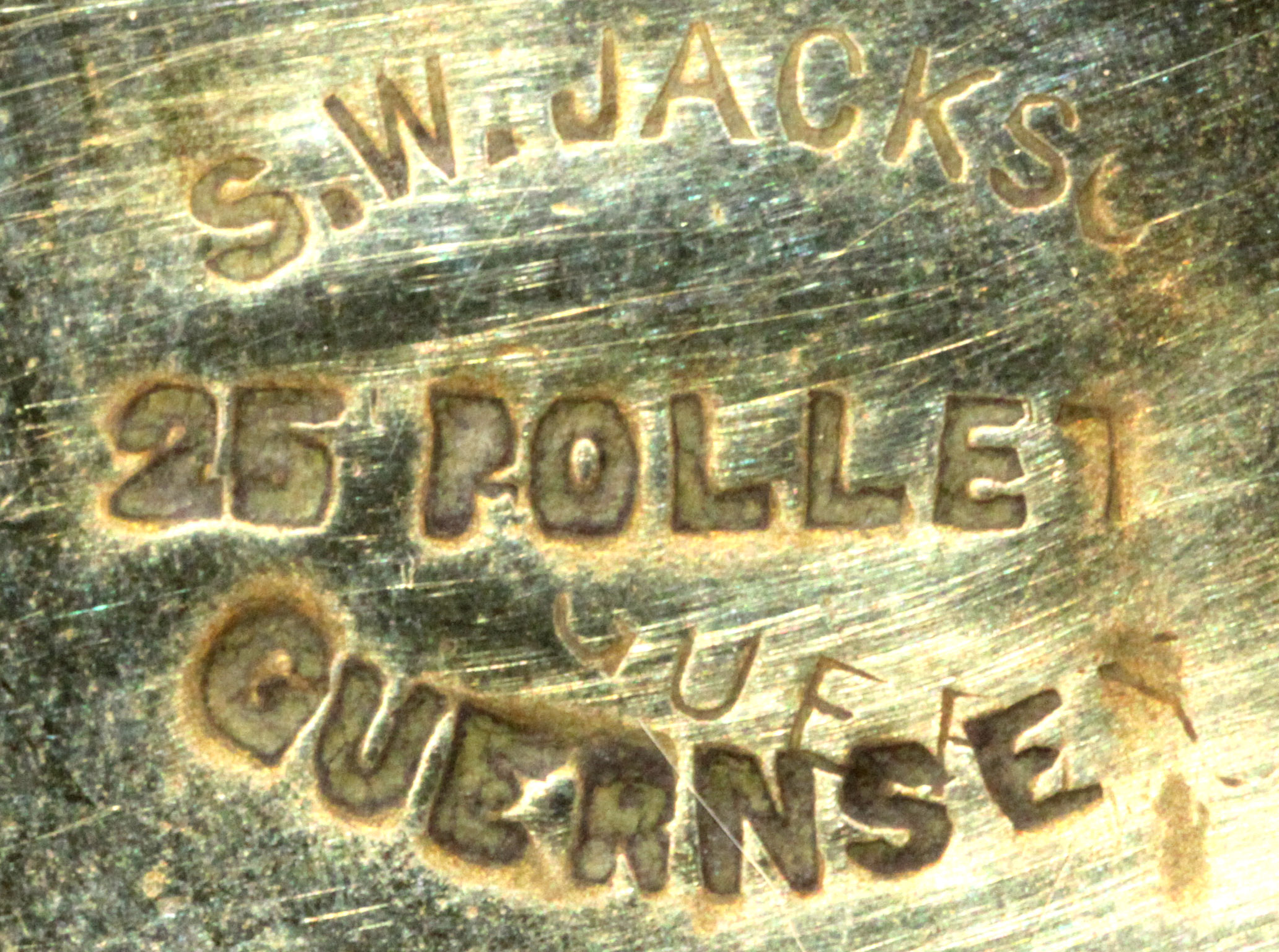
      S. W. Jackson
  Frequently there is a coin or brass token soldered to the jug showing three lions, this being typical of Guernsey coinage during the 1868-1938 period.  
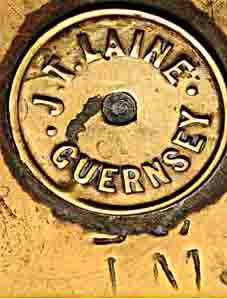
      J. T Laine, Guernsey mark over that of the actual maker, John Marston of Wolverhampton
       
    Dating a Guernsey jug by the coin is not easy despite the fact that the coinage is well documented.  Usually the coin is about 19mm diameter and shows the Guernsey shield of three lions with crest of foliage.   
  Underneath is the word ‘Guernesey’ with the extra ‘e’ typical of the French spelling of the Island’s name. This represents a Guernsey ‘Double’ coin, equivalent to an old penny and with twelve doubles to the shilling (now 5p, roughly equivalent to eight US cents).   
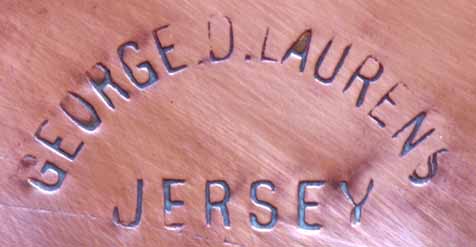
      George D. Laurens, Jersey
    The one double piece was 18.8mm diameter, 2 doubles 22.50mm and the 4 double 28.9 to 29.1 mm but all were made in coinage bronze.  During the 1939-1945 war, tokens were issued by the German occupation forces.  After 1956 the Island switched to the use of standard British coinage sizes and followed into decimalised currency.   
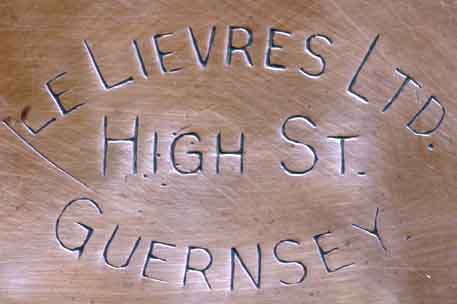
      Le Lievres
  . The majority of ‘coins’ found on Guernsey jugs are about 19mm diameter and made of brass rather than bronze, so are assumed to be tokens resembling one double struck for the purpose and that can have been used at any time.  This way, the Queen's currency was not debased.  
      Loveridge & Co. of Wolverhampton.
  The original design allows the jugs to be made by tinsmiths as well as coppersmiths.  
      John Marston of Wolverhampton
 

  Tinsmiths work usually by cutting, forming and soldering using metals such as tinned steel, zinc, copper and brass.  They do not usually undertake raising, the technique needed to make spherical hollowware before spinning lathes became available.

 
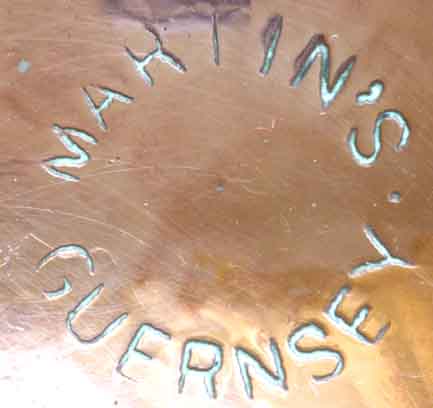
      Martins,  Guernsey The most commonly found retailer's mark.
  Originally the bodies of the jugs were made from eight sectors of copper that could be cut, dished and lockseamed for soldering.  The body is spherical with both horizontal and vertical joints.  The base has a joint lapped over the circular jug bottom.    
      A Martin & Sons, Ltd. Guernsey, C.I.
   Later manufacture has the body made from four pieces with vertical seams, one at the handle and the other directly opposite.  Later still the body was made from two spun hemispheres with no vertical joints.  
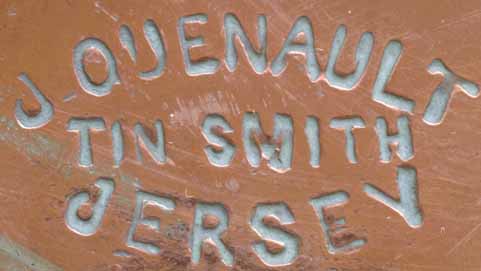
      J. Quénault, Tinsmith of Jersey on a 1927 jug.
   A parallel collar is soldered into the top of the spherical body and is closed by a domed lid.  
       
   The jugs are dual purpose, for carrying cream from the dairy and for serving it at table.  Because the lid has to be close-fitting to keep the cream in during transport, a spout is not usually fitted.   
       Earlier mark with 1901 Rd No. (Photo by Tim Hewell)
       
   Matching handles that vary in design by age and maker, are fitted to jug and lid.  Jug and lid are tinned internally to prevent any metallic taint to the cream.  The top and side handles are usually straps of copper with rolled and turned edges.  
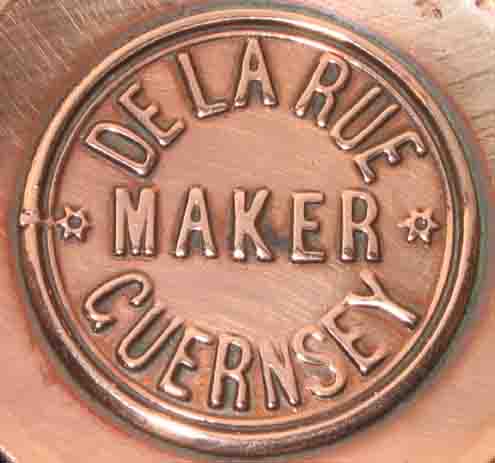
      De LaRue, Guernsey
 

  A mark of good quality is the inclusion of a supporting web of copper to make the handle stronger and more comfortable.  This is more common on the larger sizes of jug.  The value of these intriguing jugs is, not surprisingly, determined by a combination of size, design, quality, rarity, maker and condition.  Jugs of non-traditional manufacture may have fewer seams since they can be assembled from ductile copper or brass sheet that has been deep-drawn or spun to shape.  Some recent jugs are made with dummy ribs pressed in to the sidewalls to simulate the original design.


Garati Villedieu   plus a one pint capacity mark.  Made in France.   Marks U-V

  Walter Penny started learning his trade under W R James at 11, Bordage, Guernsey. His brother, Charles started in 1917 and in time they took over the business but in the name of James Penny, an uncle. They changed the registration to their joint names on his death in 1942 but were not able to be making many jugs at that time due to the occupation. In 1946 they re-opened in No 52, Bordage and in 1970 moved to No 36 Bordage.   
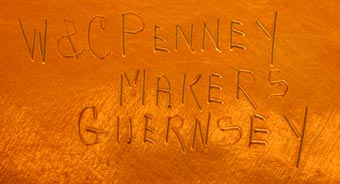
      W & C Penney, hand scribed, see more on the next page.
  Do you know of other makers?    
  Do you know more details about these makers?  
      Agnew's address without their name.


  A selection of jugs with four-piece bodies and one or two-double sized tokens soldered to the topside where one of the seams would have been in  an eight-sector body.  
  Token showing the Guernsey shield with three lions surmounted by foliage.    
       
  Guernsey cream jug of two pint size with four-piece body and fillet strengthening the handle. This was a presentation piece and is inscribed so can be positively dated to 1970 by which time more jugs were being bought by tourists than farmers. The maker's mark is 'W & C Penny Makers, Guernsey. Height 190mm (7 1/2"), weight 307g (11oz). Inscription 'Presented to FS Payne by his friends The S E B (States (of Guernsey) Electricity Board) Engineers Guernsey, May 1970'. 

This size of jug typically takes five hours to make by the traditional method. On a flat sheet of copper the required shapes are marked out using templates. The number of pieces needed varies with the type of can. Tinman's snips are then used to cut out the pieces and each one is then placed on a block of wood that has been carved with enough shapes for each item. A steel-faced hammer with polished surface is then used with great skill to block out the shapes on the former. The edges are then roll-swaged to form grooves where needed for the joints. The mating seam is formed using a hatchet stake and a wooden mallet. The components are now assembled and soldered, finish polished and proudly marked with the maker's name before sale.


  The spherical body of this jug marketed by Bachman is of eight sectors lap-seamed and soldered together and to the base and collar rim.   
       
  A dummy rib pressed in to represent a missing seam!  This is probably one of the cans made by quantity production methods in a factory in or near Birmingham.  The extra expenditure on press tooling is repaid by quicker and cheaper production costs when compared with the traditional method of lap-seaming..   
       
  Of the range of jugs shown above only three have spouts.  The one on the right of this picture is carefully rounded.  The lid, shown lifted, has an arch cut out to allow the cream to be poured.  The jug is an unidentified maker's electroplated nickel silver (EPNS) one pint version.

On the left is shown an angular spout on a Loveridge jug.  The lid is not recessed and must be lifted to allow a full stream of cream. 

 
  This top-quality handle on a six-pint Agnew jug has got a thumb grip as well as a comfortable fully webbed reinforcement underneath.  
       
  Very neat basketwork on the handle of a jug by J. Quénault of Jersey.   
       
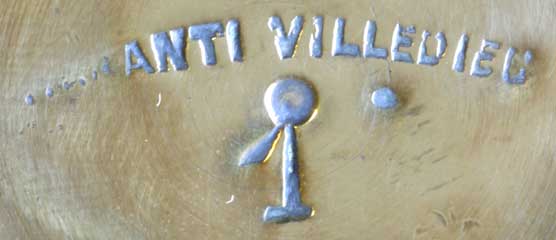
  This is a rarely seen jug, the brass body being made of two spun hemispheres with a hammered finish.  Another rarity in this jug is that the handles for lid and jug have copper  rivets to hold them in place.  The underside is marked with a '1' for a one pint capacity and a maker's quality mark missing the first few letters..... anti Villedieu; this was guaranteed made in Villedieu, Normandy.  
       
  These crinkle marks on a can body show that the copper has been pressed or drawn to shape in a die rather than hand hammered by the traditional method.  
  How do you remove dents from these thin hand made jugs with limited access?  Ask a good coppersmith!      
 

You will be told about making wooden curved stakes to support the inside while the outside is gently hammered with a soft maul and then planished to a mirror finish.  Sounds easy but it does need a lot of experience!

If the jug has been made from spinnings rather than hand raised, the copper is likely to be so thin and hard that a repair is almost impossible.


  Guernsey Cans (Coppersmiths)  

http://www.guernseycans.co.uk/


Back:   Special Topics

Makers and their Marks

Home Page